

A space to refine the heart.
Metta Dojo is an open space to open the heart via two sacred paths of ancient martial arts.
At Metta Dojo...
...we practice self-defense until there is no self to defend. Winning and losing is just a game of the mind. When there is no mind, there is no game, just peace. When we are at peace, happiness and kindness come naturally, no need to seek, no need to chase.
The full story.
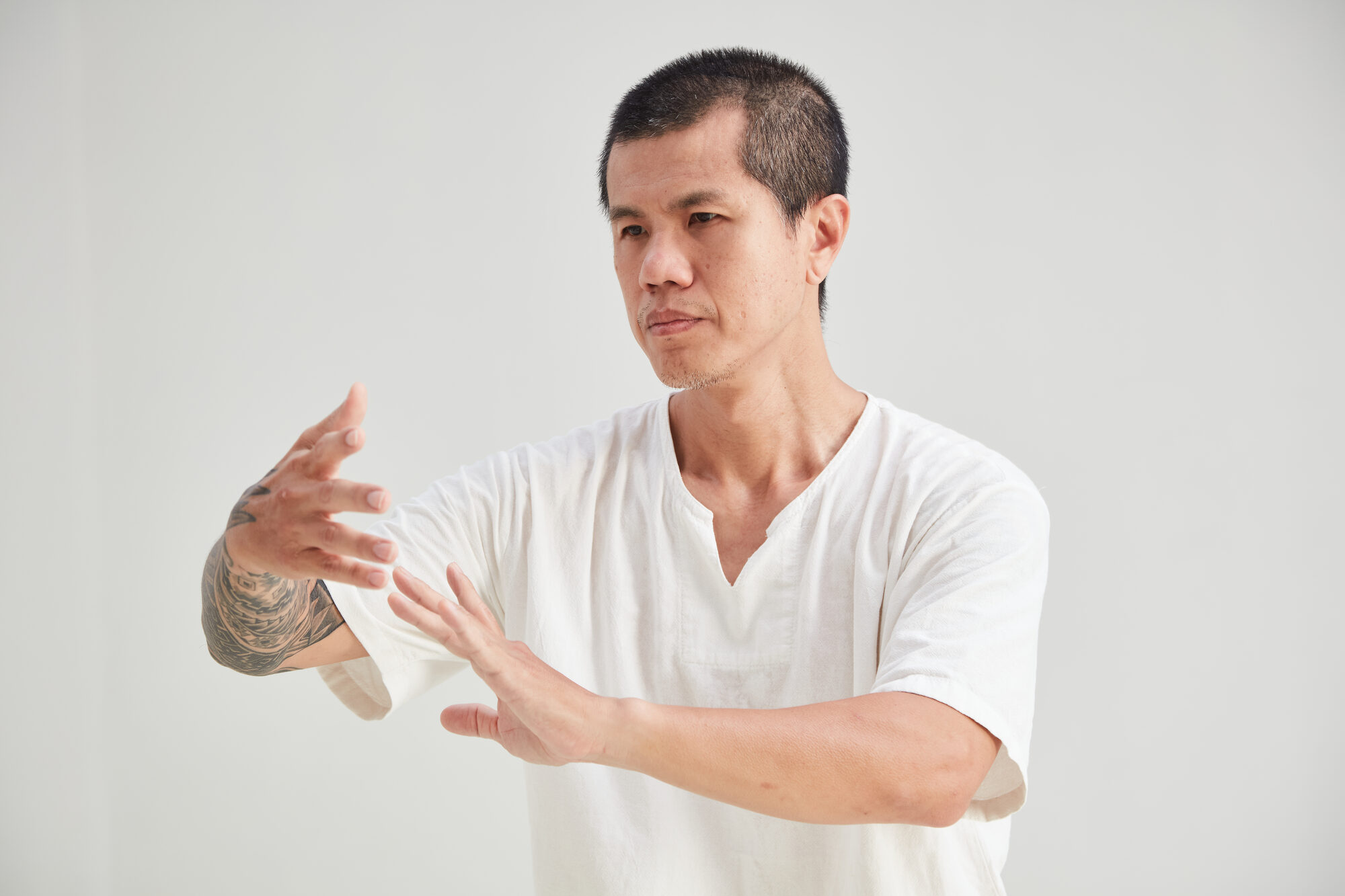
Kay began practicing Japanese Karate at the age of nine as a means of protecting himself from bullying. Over time, he came to realize that Karate was transforming him from within, cultivating a sense of calm, focus, and inner balance. In his twenties, while pursuing a Ph.D. at the University of Wisconsin–Madison, he competed in numerous regional tournaments across the United States, earning titles in both kata (forms) and kumite (sparring).
During the period Kay was earning his titles in kata and kumite, he also taught Karate through a university club. He later continued teaching in France while working as a nuclear researcher, and subsequently in Thailand, where he served as a university lecturer.
As he grew older, he found that the physically demanding nature of the Karate he had practiced since childhood was becoming increasingly taxing on his body. Sensing there was a deeper dimension to the art, he traveled to Okinawa, the birthplace of Karate. There, he explored multiple schools and styles before committing to Meibukan Goju-ryu under the Yagi family. This is now the style he practices and teaches exclusively.
While studying ancient vibrational healing traditions in Peru, he developed a heightened sensitivity to the flow of energy within and around the body. This experience led him to further training with Sifu Mark Rasmus, with whom he studied Taijiquan and Qigong intensively for three months in the mountains of Chiang Mai. He later became a student of Howard Wang, founder of Prana Dynamics in Taipei.
Recognizing that the principles underlying internal energy arts are universal, he integrates these energetic dimensions into his teaching of Okinawan Karate. In his approach, both Taijiquan and Karate are expressions of the same underlying essence, cultivating conscious awareness and directing intention to guide the flow of energy, despite their outward differences in form.
Through his academic career in nuclear physics, he came to understand that while science provides powerful explanations of how the universe operates, it often leaves deeper questions of consciousness and identity unaddressed. This realization led him to explore consciousness more directly through contemplative practices and traditional ceremonial systems.
He trained in the Sacred Valley of Peru and was later given the Shipibo name Isa Sheka (“singing bird”) by a senior healer of the Peruvian Amazon. He is also an apprentice to the chief of the Noke Koî tribe of the Brazilian Amazon. Since then, he has facilitated hundreds of ceremonial retreats, supporting psychological healing and spiritual growth through structured ceremonial practices and chanting.