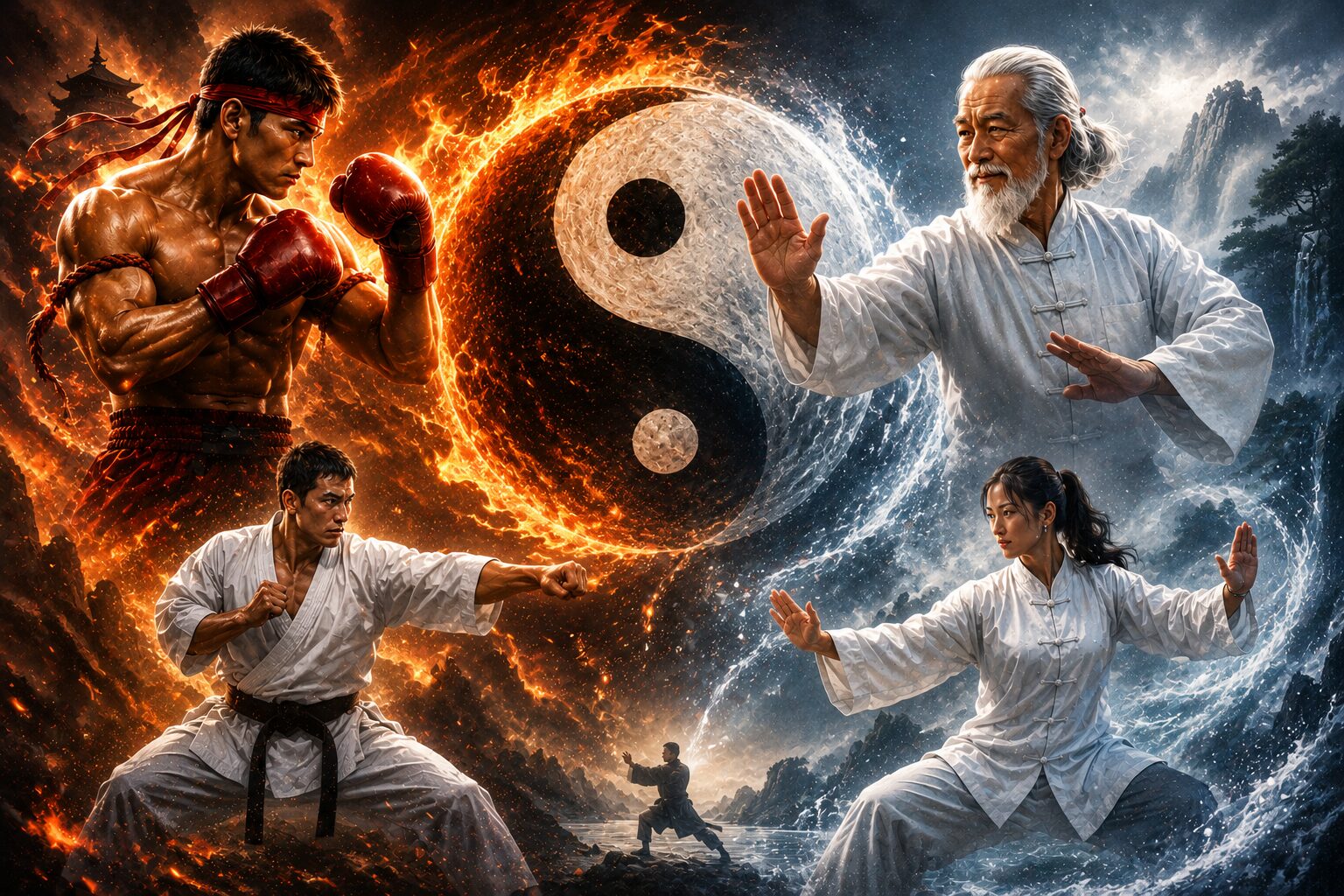
“Hard” martial arts (or external arts) here refer to systems that appear to rely primarily on muscular strength, such as Shaolin Kung Fu, Karate, Taekwondo, Muay Thai, etc. “Soft” martial arts (or internal arts), on the other hand, refer to arts like Taijiquan (Tai Chi), Bagua, Xingyi, and similar systems that appear gentle and relaxed, seemingly using little muscular force, yet possessing some kind of “internal” power capable of sending an opponent flying.
At first glance, these two categories may seem incompatible. Some people even believe that training both simultaneously creates internal conflict, preventing progress in either art. As someone who practices both Karate and Taijiquan together, I believe whether they can coexist depends entirely on the understanding of the practitioner (and teacher). If one trains “hard” martial arts using only muscular strength, or practices “soft” martial arts without developing stability (rooting) or the expansive quality known as peng (掤), merely hitting heavy bags loudly or imitating forms as instructed, then the two systems will indeed clash. But the conflict does not come from the arts themselves — it comes from misunderstanding and misguided training.
Whether in hard or soft martial arts (and even in everyday life), true power must arise from intention (yi 意), not merely from muscles or qi (氣), as many people believe. Muscles cannot express complete power without yi, and qi itself cannot move without intention guiding it. Genuine martial training is therefore the cultivation of yi — refining intention until it becomes clearer, purer, and more subtle (ultimately approaching emptiness).
The power an opponent feels does not come merely from muscle, because muscles are physically limited. But if power can be transmitted through the fascial network using a refined and pure intention, that force becomes something immense and seemingly limitless. This may sound like the plot of a martial arts fantasy novel, but I speak with confidence because I have personally experienced this kind of power from a Taiwanese internal martial arts teacher. He simply placed his palm on the right side of my chest (never the left, he said, because it could stop the heart causing death) and released force with such sharp intention that I felt pain penetrating into the bone — far more painful than being punched by trained fighters. He later told me he had used only five percent of his power; otherwise, I would not still be standing here.
So how do we know whether our martial training is headed in the right direction?
For hard martial arts, if the focus is purely on muscular tension — regardless of which muscles — without any discussion of directing force through the mind toward the target, then I consider that merely external physical exercise. That is not necessarily bad, but it is not a path that leads toward the highest spiritual goal, and it will inevitably conflict with internal martial arts.
For soft martial arts, if the focus is solely on relaxation to the point where the practitioner cannot remain stable under external pressure, or lacks the expansive structural force necessary to maintain integrity, then that may simply be a good stress-relief exercise, not martial training. And such practice will inevitably conflict with hard martial arts as well.
From a spiritual-philosophical perspective, “hard” martial arts are a path of training from the outside inward (outside-in), while “soft” martial arts train from the inside outward (inside-out). Yet both ultimately share the same destination: refining intention arising from the emptiness within the Heart center. The Heart is the center of all things, and at the center of the Heart lies emptiness — the highest truth, as described in the Heart Sutra philosophy. It is therefore no surprise that the central signboard at the Meibukan dojo in Naha reads:
奧妙在練心 (O-myo-zai-ren-shin)
“The ultimate secret lies in refining the mind.”
(I will write another article explaining this phrase in greater detail.)
For me, Okinawan Karate and Taijiquan are Yang and Yin arts that should be practiced together to refine intention and energetic sensitivity, integrating body, mind, and spirit into one unified whole — while still remaining practically applicable for real self-defense.